
Sheet’ká - Sitka Sound
Sheet’ká resounding
winds, waters, sea life welling
Shee is rebounding
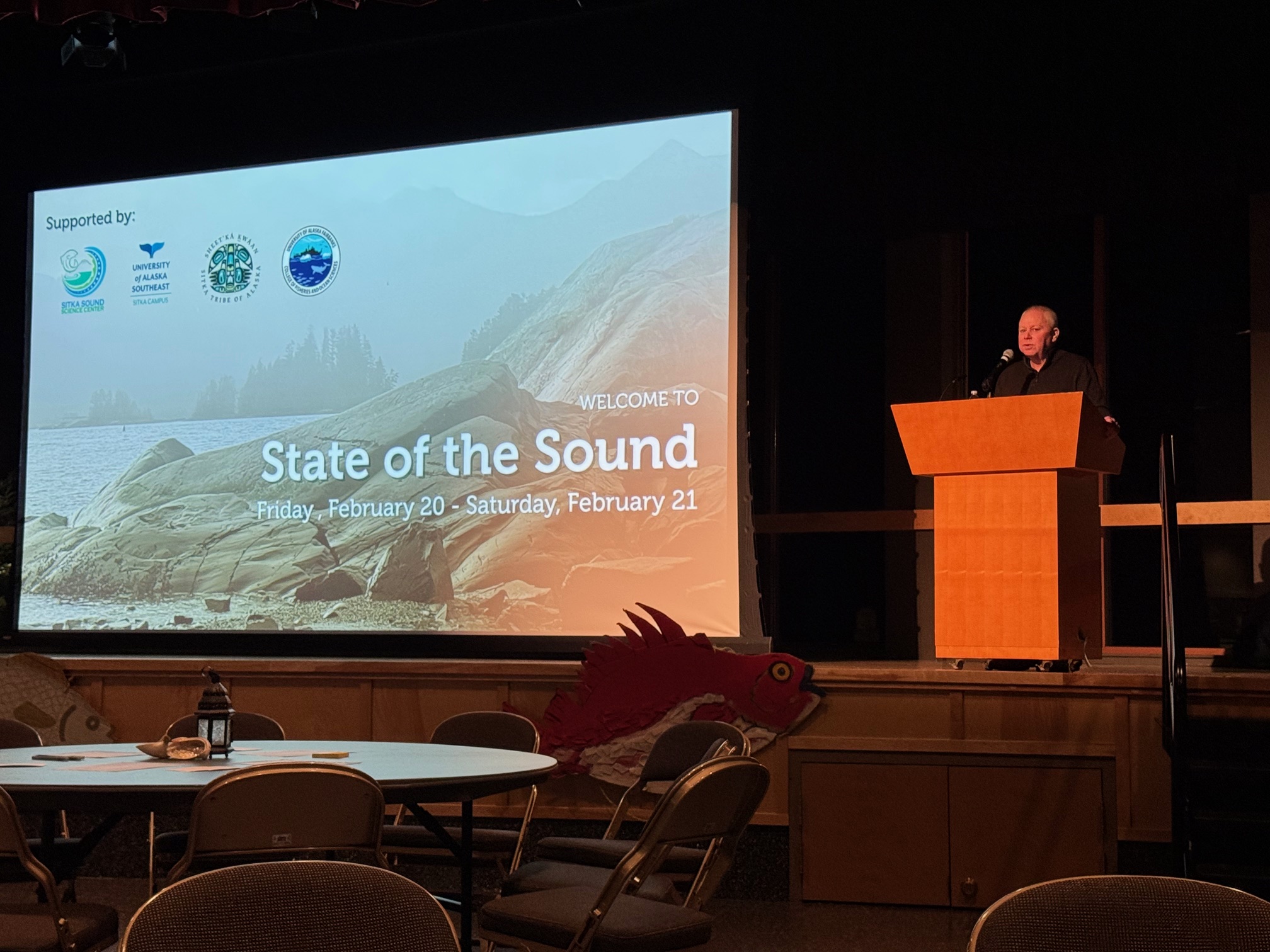
Sitka Tribe of Alaska member Mike Miller gives a keynote address at the 2026 State of the Sound symposium in Sitka.
Sheet’ká, the “Oceanside of Shee” (a.k.a Baranof Island, for the colonial Russian fur trader Alexandr Baranov), is the Lingit name for what is today known as Sitka, a town of some 8,000 residents in Southeast Alaska, about half of whom are Indigenous Tlingit. The territory surrounding Sitka, known as Sheet’ka Kwáan, “Dwelling area of the inhabitants of Sheet’ká,” encompasses a larger swath of Baranof Island (Shee) and much of southern and western Chichagof Island (Seilḵ), two major islands that define the archipelago. Sitka Sound is the geographic and cultural center of this array—the hub and heart of Sheet’ka Kwáan territory.
Indigenous place names are dense in Sheet’ká, reflective of its abundance, diversity, and cultural significance. Sheet’ká’s wealth supported the largest Tlingit population in Southeast’s Alexander Archipelago for thousands of years. Thickly descriptive, these Native names highlight many of the seascape’s outstanding landmarks, hazards, and treasures: Taan Daa (Jumping [Fish] Surround [an Island]), Aanyakax’áat’x'i (Little Islands in Front of Town); Yaaw Teiyí (Herring Rock), Íxt’i’ X’aayí (Shaman Point), Dagák Héen (Little Sockeye Creek), K'wát' X'áat'ax'u Sáani (Little Islands with Bird Eggs), Neixinté Seiyí (Area Below the Blue-Green Claystone [used for paint]), and so on. Together they plot the seasonal round and historical geography of existence in this extraordinary place.
In the spring, the Tlingit have enjoyed Sitka Sound's abundant herring eggs, bird eggs, halibut, sea mammals, seaweeds, and shellfish; in the summer the five Pacific Salmon among other fish, crabs, berries and greens; and in the fall and winter, deer, seal, various other land and sea animals, and late runs of salmon and other fish. Sheet’ká remains a rich, diverse, and dynamic ecological system, nourished by America’s largest coastal temperate rainforest, its watersheds, and the rich Pacific currents, oscillations, and upwellings that feed it. The Sound’s place in the Pacific “Ring of Fire” of volcanoes also plays a role in this. Shee, the Volcano Woman for whom Baranof Island is named, was said to dwell in L'úx (Blinking, a.k.a. Mt. Edgecumbe) on Kruzof Island, at the edge of Sikta Sound, which was still active (blinking, if not erupting) when the Tlingit arrived in Sheet’ká.
Modernity has brought many new people, enterprises, and institutions to Sheet’ká: commercial fisheries, hatcheries, ocean farms, and processors; national parks, marine parks, seabird and wildlife refuges; airports, lighthouses, and the Coast Guard; docks, boat launches, and marinas; ferry, cargo, and cruise ship terminals; government and its offices; museums, aquariums, furriers, libraries, and campuses; hotels, BnBs; charter fishing boats, tour boats and tourists; a pioneer home and pioneer bar; and more than a few churches.
With all this new activity, the Sound, while never static, is changing in profound ways. There are more extreme events—marine heat waves, thunderstorms, atmospheric rivers, landslides, avalanches, and the like. New or seldom seen species are washing in, while some old inhabitants, like wild King Salmon and halibut, are becoming scarcer. How are we to understand and respond to these changes? It takes a dedicated community of scientists and Indigenous and other local experts to makes sense of the many facets of change, including their often-complex causes and cascading effects.
Thus, was born the first State of the Sound in February 2026, led by the Sitka Sound Science Center (https://sitkascience.org/stateofthesound2026/). The web invitation reads as follows: “All are welcome to join our first-ever State of the Sound conference: a three-day gathering where people who live and work in the Sitka area come together to share what we are seeing, learning, and noticing about the lands and waters surrounding Sitka Sound. Community knowledge-holders, culture bearers, researchers, students, and partners will connect across perspectives to build a fuller picture of what we know about our local environment, what we are still learning, and why it matters.”
Educere, from the Latin “to draw out” and “bring forth,” is an apt way to consider the State of the Sound as a forum for understanding and responding to Sheet’ká’s strengths, vulnerabilities, and needs. It takes stock of the deep knowledge and relations that inhabitants possess through myriad channels of engagement with the Sound and weaves them together. One perspective, or “peephole,” as John Steinbeck suggests in introducing Cannery Row, is not enough to comprehend the complex interrelations and flux and flow of life in a coastal marine system. Ultimately, the State of the Sound is about pursuing a collective education to bring forth the best knowledge and care for Sheet’ká, so she continues to provide all that her diverse dwellers need.
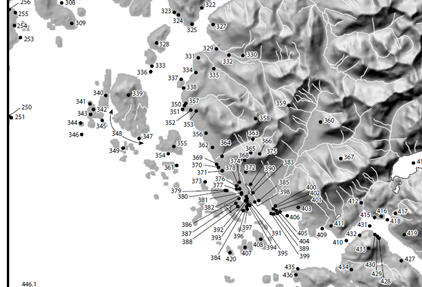
A concentration of Tlingit-named sites in Sheet’ká, Sitka Sound, Alaska. The densest cluster lies in front of the modern town of Sitka on Shee (Baranof Island). (From Haa Léelk'w Hás Aaní Saax'ú: Our Grandparents' Names on the Land, T.F. Thornton, ed. 2012)
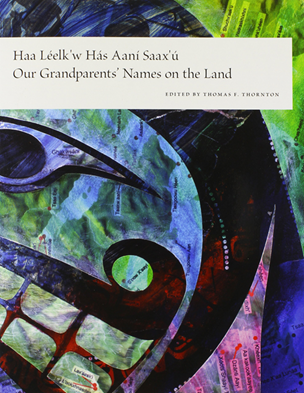
Thornton, T.F. (ed.) (2012) Our Grandparents Names on the Land. Seattle: University of Washington Press.